Showing posts with label Job. Show all posts

Sunday, November 17, 2013

Is Everyone Impoverished by a Low Cost?


Recently, a framer said to me, "The wages for framing has started becoming unable to live on."

Framing is a basic construction where they build the structure(framework) of a building. To assemble and install big pillars, walls and beams results in several framers' working on-site 1 week through 4 weeks.

The reason for having a wide range of the period is that there is a difference between the case where walls and other things are built in advance in a factory and brought, and where all of them is built on-site.

In recognition of not wanting to have exposed the frame to the rain over a long period of time, these days the way of building it to some extent in a factory (panel construction) is the main current; but the time when a path leading to a site is narrow and a large-sized crane and a truck don't come in results in framers' building it from the ground up on-site though it takes time (conventional method of construction).

Yet I hear because a sum of money proposed by builders to subcontract framers and carpenters has started getting smaller in this day and age, the wages paid to the framers who come and help on-site is decreasing a net income of the main framer who made a plan.

I probably think the framer doesn't actually live so uncomfortably, yet framers and carpenters who accept the work of low-cost builders are going to have a harder time.

I hear if things don't work out, their wages are about the same as company employees' salary.

Now the regular wage for framers and carpenters is about 20,000 yen a day. If they work 25 days, they get 500,000 yen. When you hear it it sounds as if they earn more than the public, but how about it if you think of social security deduction, traffic expenses, a tool bill, a vehicle bill, consumption of strength, not any bonuses?

They work a 25-day month, which means they aren't on a five-day week, and if you think about of course not including the Bon holidays, the New Year holidays, holidays and unworkable days because of rain, to make 500,000 yen a month is pretty difficult.

Of course the case of not full-time employment but a contract which has decided the total price usually gets all the more profitable depending how hard they work. That is because if they finish construction sooner than usual because of reporting to work early and overtime work, construction period is short, so the price of the number of days gets more, but because the contract price is itself the very lowest, the work of framers and carpenters who do quickly and want to earn money eventually gets sloppy.

Customers ought to be satisfied with being able to build their house affordably, but site workers who execute it also have their living to concern themselves with. If a low cost puts a strain on their living, it is plain that it will also put a strain on building a house.

There are no present contractors including framers and carpenters who excessively demand profits. Few builders like us who have been putting them together ought to be thinking of trying to make a large profit, too.

There was news that SHARP Corporation has recently run a huge deficit.

A severe price competition makes even company's continuance dangerous. If a company cannot continue, customers cannot receive after-sales service and maintenance. And the employees and business partners cannot make ends meet too.

That impoverishes in turn Japanese society too, and leads to price wars here, there and everywhere. These are the realities of deflation. After all, all of us lose money.

Please don't forget that has been happening also in the present housing industry.

Going through grinding competition is necessary, but I believe the intense competition more than it could put industry and society themselves out of business.

Budget may sometimes be tight, but despite all that contractors and builders receive moderate compensation and do quality work. And then, they both thank each other. Wouldn't that has been originally what building a house ought to be?

Wednesday, September 26, 2012

These are Also Red Bricks. -Vermont-


The exterior brick has a Waterstruck texture.

Is it named this because there are signs that look like the brick has absorbed water, or that jets of water has made this texture?
 
Either way, even a flat surface type of brick can bring out this antique impression.
 
This brick (Modular) is a little smaller than the MAX size we usually use. It's 7-5/8'' long and 2-1/4'' high.

There are as many as 10 small holes to put a rebar through it, but this may make it difficult for a thick rebar we use to get entangled with the mortar tightly.

In that respect, this Hanson brick doesn't seem to be suited for Japan.


But this colour which looks like having some dark brown has a more sophisticated atmosphere than a usual red brick, wouldn't you say?

A picture of the brick's building looks bright as it gets sunlight, and the change of colour also gives a very good effect.
 
They are indeed genuine Canadian laid bricks, aren't they?
 

Because Brick is Simple, the House is So Beautiful. -Madere-


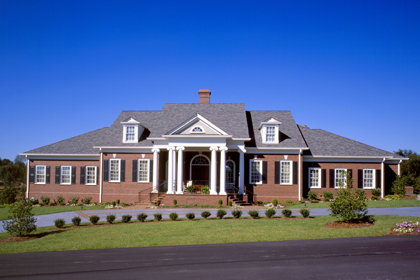
These are orthodox red bricks. These bricks seem to be everywhere, but how will they look when they are piled up into a large wall?
 
As I wrote before, Hanson Brick conspicuously has a real presence that no other companies' bricks can have regarding size and texture.

Bricks from Toronto, which has a brick-cladding history, is manufactured bearing in mind how they'll look when laid together.


How do you feel about the house whose exterior is decorated with this brick?

The contrast is exquisite: white with shades of ivory in the garage, window and the eaves of the roof, dark brown in the garage door, black roof and red wall.

Also, because there's a difference of altitude on the floor between a residence area and a garage area, the house shows a rhythmical exterior, too.

The rhythms of regularly laid bricks to this rhythm are harmonious.

The design of Canadian bricklaid houses are wonderful, but we at HOME MADE alone import this brick into Japan.

That's exactly why this design can be realized by HOME MADE even in Japan.

High-grade Hanson Brick having both low moisture absorption efficiency and firmness because the bricks are baked hard.

Something can be built of only costly brick.


Sunday, May 9, 2010

Foundation for brick cladding


This is the foundation for a brick wall and there is outside of the foundation for wood structural framing. The width is 6 inches.

You can also confirm the thickness of the ferroconcrete in the photo.

It is enough to withstand the heavy brick wall to stand up vertically.

The nice thing about this brick foundation is to be on the same base as foundation of the building frame.

So, even if ground subsidence has occurred, brick wall and building frame will go down together and it does not cause trouble by the only one side subsidence.

Thursday, April 1, 2010

Wrought Iron Grille is good for crime prevention


In Japan people uses aluminum grille for windows but it is easy to break and it is not helpful for crime prevention.

Because it is hollow core and thin. So, it will occur deterioration soon.

And it is fasten by screw or bolt on a wall. So, we can remove it easily.

But I, Home Made make a wrought iron grille even such a big window.


The iron parts are welded all and they are made of solid iron. You cannot break the grille easily.

Though you may not find some twisted ballusters in the grille, it looks nice a little.

When I install it on a wall, I use some anchor bolts. So, you can hang on to the grille.

At the last I make the bolt head into a ball. Then you cannot turn the bolt.

I do not install a fake grille on a window. It is important to put a thing to practical use and design.

However, please be careful. You cannot go out from inside here.

Friday, March 26, 2010

Our roof insulation is the absolute!


In Home Made, the asphalt shingle made in North America is usually used.

This roofing material is comprised of asphalt and glass fiber. So, it is light and highly flexible.

And the color of the surface is taken out by a grain of a natural stone and there is no color fade. It's different from Japanese painted roof material.

It is guaranteed for 30 years, though Japanese one should be painted after 10 years.

This roof material is soft, therefore, it was difficult to install some outside ventilation system in the roof up to now.

We are settled by high-density polypropylene which is twined like a net on the roof wrap sheet (shown it as white sheet in photo).

When you use an attic as a room, it will block heat from a roof off. And we install cellulose fiber insulation in the rafter. So, we achieve the double heat insulation system on the roof.

Air (humidity) goes through the roof wrap sheet, but water isn't let through it.

Even if interior humidity is passing through roofing plywood, we become able to release humidity at the space made by the polypropylene net for ventilation.

The other house builders install asphalt roofing sheet directly on the roof plywood as waterproof sheet. So, dew condensation is caused between the waterproof sheet and the roof plywood. And they cannot resolve the problem that water degrades plywood.

Of course, We, Home Made, use the cellulose which has function of absorption and desorption of moisture in a roof. And I also get the inside ventilation system to release humidity from a ventilation layer inside the roof.
Even if this outside ventilation system isn't adopted, roofing plywood isn't degraded.

Therefore to save the budget at the house building, I think it isn't even necessary to install the outside ventilation system, if you do not use an attic area.

Dulability depends on as natural providence and high quality in building technology.

You also know that a low-cost isn't compatible with high quality of course, right?

Saturday, March 13, 2010

It's just Drywall!


Here is C's house in Moriyama-ku. The completion drew at the middle of next month. Now I am building in the most interesting part.

Carpentry work was alomost completed, and equipment and appliance will be installed accordingly.

An interior image is light natural feeling, but it adds with sophisticated elegant. I coordinate the interior as the photo, so that visitors might impress.

I take the photo at the same angle as I introduced the drywall preparation on the former post.

(Please check with a picture of following related blog article.)

When it's painted by Canadian PARA paints, beauty of the arch is the best.


And here is double hung windows with the half circle in front of the kitchen sink.

It was decorated with the wood trim moulding painted in white. Indeed, we feel the elegant atmosphere.

The colour of kitchen cabinet is pure white, too. So the contrast with the color of the wall is also elegant, isn't it?

Of course, I was considered them with my customer one by one.

I always consider a house design with much time. when it becomes real, customers are deeply moved, right?

That's, we, Home Made's true value.


< Related blog article >

Drywall Preparation :
http://buildinginhomemade.blogspot.com/2010/03/drywall-preparation.html

Thursday, March 11, 2010

Run-on Work in M's project, Nishio city


The completion drew near at next week's end. Small jobs are still remaining there. though I have to do work much, now M's house building construction is in progress smoothly.

Installing a kitchen and equipments, concurrently, Coloring and painting are being done in sequence.

The oil named the color, "Olive" is coated on a solid pine flooring this time.

This natural oil paint added yellow to the dark brown a little.

While there are a lot of customers who like reddish brown recently, this customer choses the original color.

The wooden door, the frame and the interior mouldings are applied by this olive color.

The oil has no gloss because it's natural oil, but natural gloss is coming out one after another.

And the color of the flooring is also becoming dark one after another because of solid wood. After 10 years, it would be the quite antique interior.

Please image it and the color had not better be satisfied at the building completion. It's quite difficult, but important.

Oh, it's same as seasoning of a dish, isn't it?

Friday, February 19, 2010

Good Job, Canadian Guys!


We almost completed a construction frame work of N's project in Ohbu.
Now we have worked with Canadian framers at frame work and their job looks so nice and speedy.
Since I asked them a framing at C's project in Moriyama, they are working together. Because they are earnest on work and their skill is excellent.
So, my jobsite is always clean and accurate.
Japanese always says that Japanese works hard, but regarding house building, I think they have a craftmanship.


In this picture they put a plywood on the rafter as underlayment for roof.
They are men of iron nerves in such steep slope!
Do you want to build a real western style house by Canadian framers?